Clinical studies involve multiple teams, complex datasets and a series of interdependent activities. From clinical data management and biostatistics to statistical programming and regulatory submission, each function relies on accurate, consistent and well-structured information.
When these activities are not aligned, even relatively straightforward studies can become difficult to manage. Differences in data structures, programming approaches, documentation and review processes can lead to inconsistencies, repeated work and delays.
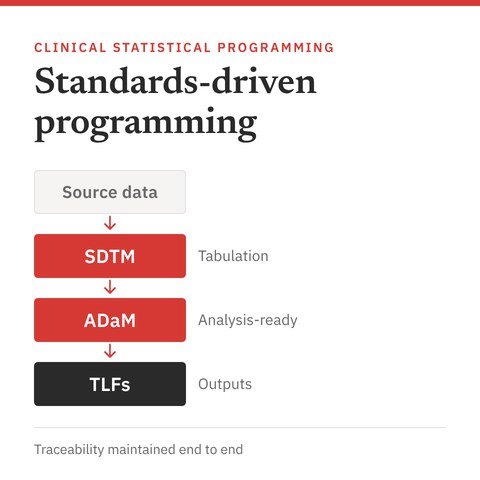
Standards-driven programming helps address these challenges by establishing a consistent framework for how clinical data is structured, transformed, analysed and delivered.
Two standards are particularly important in this process: the Study Data Tabulation Model (SDTM) and the Analysis Data Model (ADaM), both developed under the Clinical Data Interchange Standards Consortium (CDISC).
However, their value extends beyond data formatting. When implemented effectively, SDTM and ADaM influence how a study team organises its work, manages responsibilities, reviews deliverables and maintains quality throughout the clinical development process.
1. Creating a common structure for clinical data
One of the biggest challenges in clinical programming is working with data collected from different sources and systems.
Clinical studies generate information across multiple domains, including demographics, adverse events, laboratory results, medical history, exposure and efficacy assessments. These datasets may originate from different systems and follow different structures.
Without an agreed approach, programmers may spend considerable time understanding source data, resolving structural differences and interpreting specifications before meaningful analysis can begin.
SDTM provides a standardised structure for organising clinical trial data into defined domains and variables. It establishes a common framework that helps different teams understand and work with study data consistently.
For the programming team, this means:
- A consistent approach to mapping source data into standard domains.
- Clearly defined variable names, structures and controlled terminology.
- More predictable dataset organisation across studies.
- Easier collaboration between data management, programming and biostatistics.
- Improved consistency when preparing regulatory submission datasets.
The benefit is not simply that datasets follow a recognised format. It is that everyone involved has a clearer understanding of how the data is organised and where specific information can be found. Where a sponsor maintains standards centrally, a well-used metadata repository can reinforce that consistency from one study to the next.
2. Establishing a clearer path from source data to analysis
While SDTM focuses on the organisation and tabulation of clinical data, ADaM provides the structures needed to support statistical analysis and regulatory review.
ADaM datasets are designed to support the production of statistical analyses, tables, listings and figures (TLFs). They also help maintain traceability between analysis results and the underlying source information.
This distinction is important for a study team.
A well-planned SDTM-to-ADaM workflow establishes a more structured relationship between data collection, standardisation and statistical analysis. For example:
- Clinical data is collected and transferred from source systems.
- Source data is reviewed, reconciled and mapped into SDTM domains.
- SDTM datasets undergo validation and quality control.
- ADaM datasets are developed using approved specifications and analysis requirements.
- Statistical outputs are generated from the analysis datasets.
- Independent review and validation are performed before final delivery.
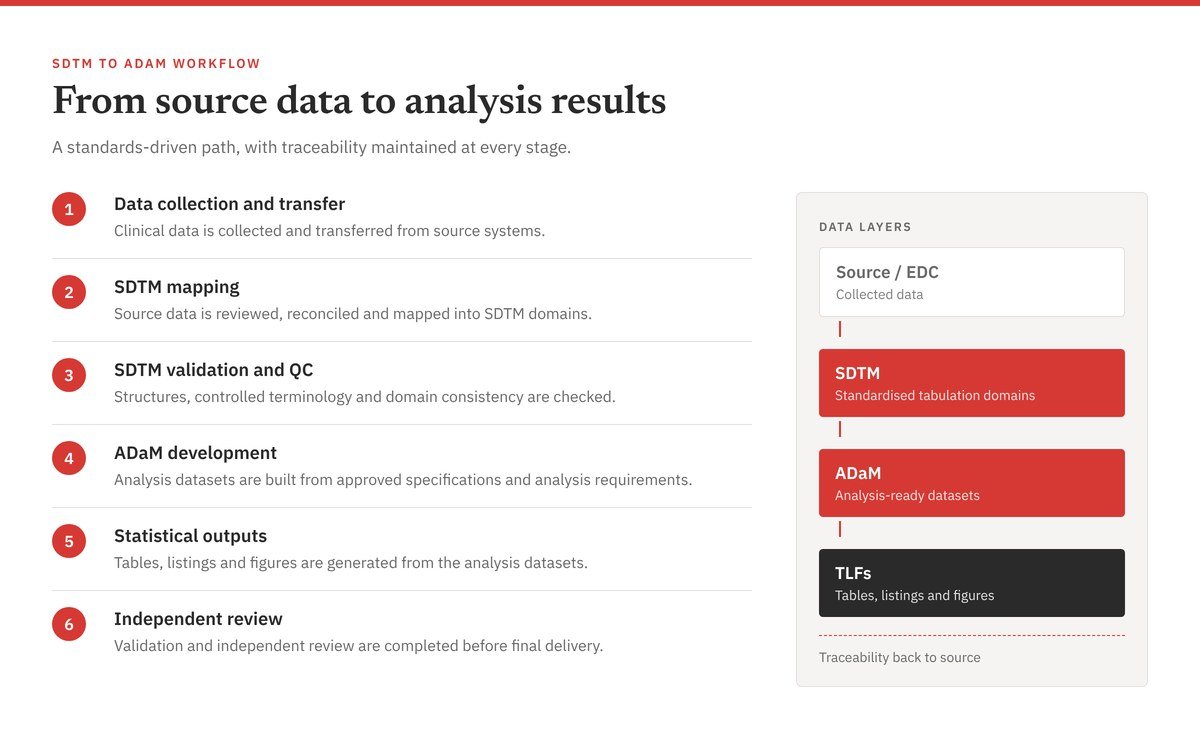
This approach gives programmers and statisticians a clearer understanding of how each dataset contributes to the final analysis.
It also makes it easier to investigate discrepancies, reproduce results and identify where an issue originated.
3. Changing how programming work is planned and organised
Standards-driven programming requires more planning than simply writing programs to produce a required output.
The programming team needs to understand the study protocol, data collection structure, CDISC implementation requirements, analysis objectives and reporting expectations before development begins.
This changes how work is organised.
Instead of treating each programming task as an isolated activity, the team works within a coordinated framework involving specifications, dependencies, programming conventions and agreed deliverables.
Some important considerations include:
Specification development
SDTM and ADaM specifications define how variables are derived, populated and structured. Clear specifications reduce interpretation differences between programmers and reviewers.
Programming conventions
Consistent naming conventions, reusable macros, standard programming practices and documented procedures make it easier for multiple programmers to work on the same study. Our good programming practice guide sets out the conventions we apply across studies.
Task dependencies
SDTM development generally precedes ADaM development, while analysis outputs depend on the availability and approval of the relevant analysis datasets. Understanding these dependencies helps project managers allocate resources and plan realistic timelines.
Documentation
Programming decisions, derivations, deviations and data handling rules should be documented appropriately. This creates a reference point for future reviews and maintenance.
The result is a more coordinated programming environment in which individual tasks contribute to a defined study-level delivery process. Oversight, standards, programming environments and reusability remain recurring challenges in reporting clinical trials, and a standards-driven approach is one way of keeping them in view.
4. Making review and quality control more consistent
Quality control is not something that should happen only when programming work is complete.
In standards-driven programming, quality considerations are incorporated throughout the development lifecycle.
Standardised structures and documented specifications provide reviewers with a consistent basis for checking whether datasets and outputs meet the agreed requirements.
For example, SDTM validation can identify issues involving variable structures, controlled terminology, required variables and domain-level consistency. ADaM validation can help identify structural and metadata issues, while additional programming review is needed to confirm that derivations and analysis requirements have been implemented correctly.
Quality control may include:
- Comparing programmed datasets against approved specifications.
- Checking variable attributes, lengths, labels and data types.
- Reviewing derivations and analysis population definitions.
- Verifying consistency between SDTM and ADaM datasets.
- Checking traceability between analysis variables and source information.
- Independently validating statistical outputs through double programming or other appropriate QC procedures.
- Investigating and documenting validation findings.
It is important to recognise that passing automated validation checks does not automatically mean a dataset is scientifically or operationally correct.
A dataset can be structurally compliant while still containing incorrect derivations or inconsistencies with the study protocol.
Effective quality control therefore combines automated validation, programming review, statistical review and an understanding of the study requirements. Our data integrity checklist for statistical programmers covers the day-to-day checks that support this.
5. Improving traceability and supporting regulatory review
Traceability is one of the most valuable outcomes of a well-implemented CDISC framework.
During a regulatory review, it may be necessary to understand how a particular analysis result was derived and which underlying data contributed to it.
ADaM supports this through defined structures and traceability conventions that help connect analysis results to their source information.
For programming teams, maintaining this relationship requires careful consideration of:
- Source variables and their corresponding SDTM variables.
- Analysis variables and documented derivation rules.
- Analysis population definitions and selection criteria.
- Parameter definitions and calculation methods.
- Metadata and supporting documentation.
When traceability is planned from the beginning, investigating questions and resolving discrepancies becomes more manageable.
It also reduces dependence on individual programmers’ knowledge of how a particular dataset or result was produced.
For sponsors and CROs, this can make regulatory preparation and subsequent study maintenance more predictable.
6. Encouraging better collaboration across study functions
Standards-driven programming is not exclusively a statistical programming responsibility.
Its success depends on coordination between several functions, including clinical data management, biostatistics, statistical programming and regulatory affairs.
Each team contributes different information and expertise.
| Study function | Contribution to standards-driven programming |
|---|---|
| Clinical Data Management | Provides structured clinical data and supports data cleaning and reconciliation. |
| Biostatistics | Defines analysis requirements, estimands, endpoints and statistical methods. |
| Statistical Programming | Develops SDTM and ADaM datasets, implements derivations and produces statistical outputs. |
| Quality Control | Reviews programming accuracy, consistency and compliance with specifications. |
| Regulatory Affairs | Supports submission requirements and coordinates regulatory documentation. |
When these teams work with agreed standards, specifications and communication procedures, there is less room for conflicting interpretations.
For example, early communication between biostatisticians and programmers about analysis requirements can help identify potential ADaM design issues before programming begins.
Similarly, early agreement on SDTM mapping rules can reduce repeated discussions and corrections later in the study.
Standards provide the common framework, but effective communication ensures that the framework is applied correctly. Where a team is new to CDISC, structured training and knowledge transfer helps that shared understanding develop faster.
7. Reducing rework without assuming standards eliminate complexity
A common expectation is that standardisation will automatically reduce programming time.
While standards can improve efficiency, the benefits depend on how consistently they are implemented.
Clinical studies still have unique protocols, endpoints, data collection requirements and analysis needs. Even when two studies follow the same CDISC standards, their programming requirements may differ considerably.
However, a well-established standards-driven approach can reduce unnecessary variation.
Reusable programming components, established specifications, documented conventions and consistent QC procedures allow teams to build on previous experience rather than repeatedly solving the same structural problems.
This can help reduce:
- Repeated programming caused by inconsistent specifications.
- Unnecessary corrections arising from unclear requirements.
- Time spent understanding unfamiliar dataset structures.
- Review difficulties caused by inconsistent programming practices.
- Delays associated with missing documentation or incomplete traceability.
The objective is not to eliminate study-specific programming challenges. It is to manage them within a consistent and controlled framework.
Making standards work in practice
Implementing SDTM and ADaM effectively requires more than familiarity with CDISC documentation or the ability to run validation tools.
It requires experienced programmers who understand clinical data, statistical analysis, programming standards and the practical requirements of regulatory submissions.
It also requires a structured approach to project planning, specification development, documentation, independent QC and communication across study functions.
For sponsors and CROs, choosing a statistical programming partner with practical CDISC experience can make an important difference to the consistency and reliability of study deliverables.
At Shafi Consultancy, we support pharmaceutical companies and CROs with specialist statistical programming and clinical data solutions, including SDTM and ADaM implementation, TLF development, independent validation and quality control, and programming resourcing and support.
Our approach combines technical expertise with a strong focus on data integrity, traceability and dependable delivery. Our conference papers and presentations set out how we have applied it across studies.
Whether supporting an individual programming requirement or contributing to a wider clinical study, our objective is to help study teams produce accurate, consistent and submission-ready deliverables.
Explore our statistical programming and CDISC implementation services to learn how our team can support your clinical development programmes.
Conclusion
Standards-driven programming changes more than the structure of clinical datasets. It changes how programming activities are planned, how responsibilities are coordinated, how deliverables are reviewed and how the relationship between source data and statistical results is maintained.
SDTM provides a consistent framework for clinical data tabulation, while ADaM supports analysis-ready datasets and traceability.
Together, they help establish a more organised, transparent and quality-focused programming environment.
Ultimately, the value of standards is not simply compliance with a technical specification. It is the ability to make clinical programming work more consistent, reviewable and dependable throughout the study lifecycle.